

Ten Stages of Kagame's Dictatorship
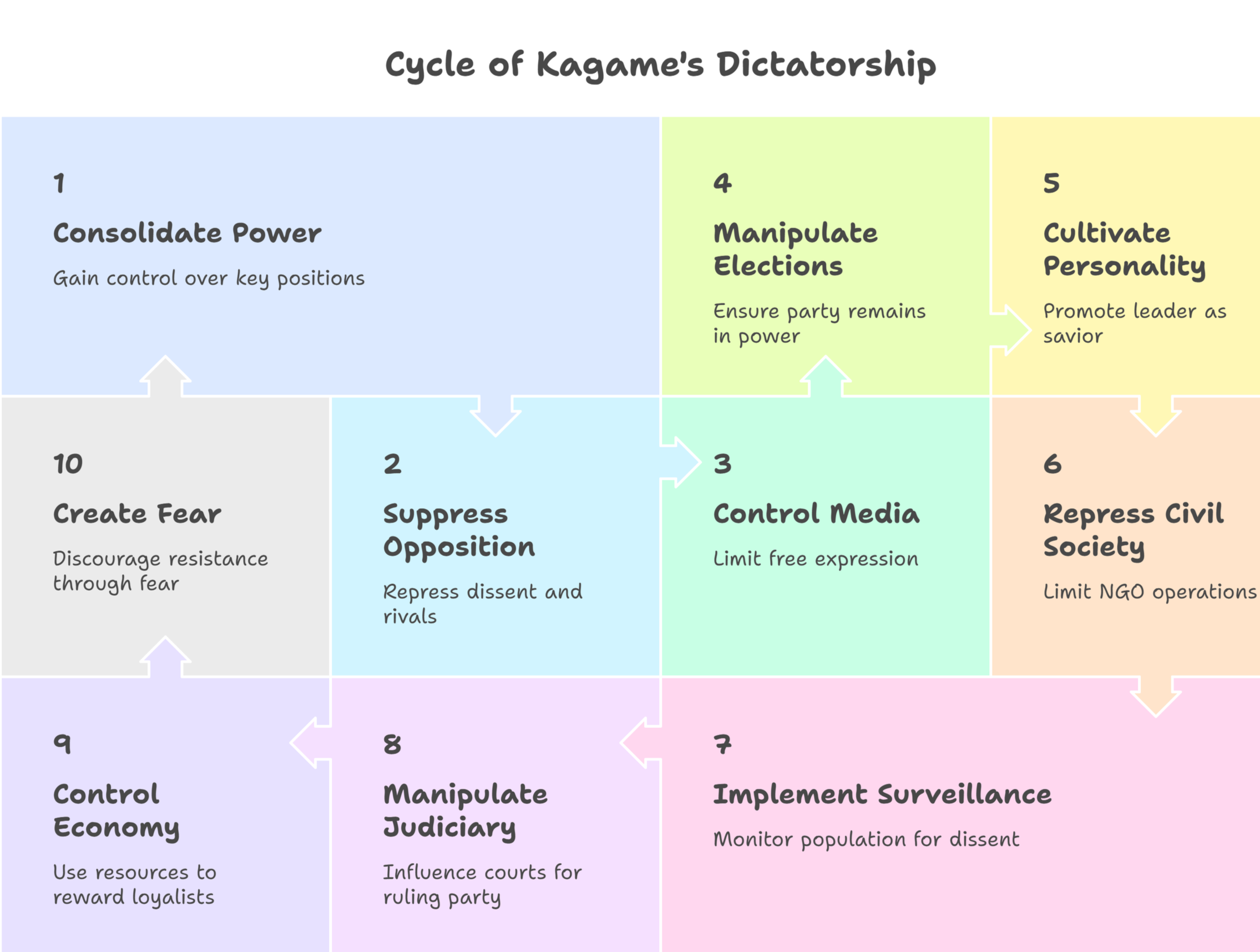
NIGUTE TWISANZE TUYOBOWE NA GATSIKO KA AMABANDI
The Phases of Dictatorship in Rwanda Under the RPF
Stage 1
The RPF Inkotanyi had a legitimate cause to fight at the beginning. The Habyarimana regime was a dictatorship rooted in ethnic violence, which gave the RPF a just reason to launch a revolution — one they ultimately succeeded in. Their cause was clear, well-communicated, and widely believed in. People trusted them enough to send their sons, their money, and their loyalty. Many were willing to die for that cause.
But one mistake Rwandans made was believing that changing a regime automatically brings democracy. Most people think democracy is secured the moment a regime is replaced. In reality, democracy dies when those who take power begin controlling the economy, dominating the media, eliminating space for opposition, and manipulating election results to entrench themselves.
Stage 2
Creating a false narrative of equal opportunity is common at the beginning of a dictatorship. The regime uses past injustices to justify and manipulate the idea of fair sharing.
The Kagame regime created many policies claiming to ensure equal opportunity. One example is the FARG education fund, which was designed to help genocide survivors access education — a genuinely good idea in principle. But it ultimately created new divisions, defining a narrow category of "true victims" while excluding others who also suffered.
Stage 3
The regime begins to define who is a friend of the state and who is an enemy.
Those identified as friends turn out to be members of the ruling party which means, by default, everyone is forced to belong to that one party. Questioning the party becomes one of the most dangerous acts a citizen can commit, turning any critic into an "enemy of the state."
Mafia-like loyalty rules emerge both within the party and across the country. Members are required to swear absolute loyalty to the party. Those who try to remain neutral or take both sides are publicly labeled with degrading nicknames — for example, Jean-Paul Sampotu being called "gutandaraza," meaning traitor of the party.
Stage 4
Loyalty to the party becomes everything. The RPF created figures like Bampora iki to promote unconditional loyalty to the party among the population. This stage is dangerous because it lays the groundwork for propaganda.
Stage 5
The regime creates deliberate confusion until ordinary citizens no longer know what is right or wrong, what is legal or illegal. At this stage, the judiciary begins operating like a mafia — governed by group orders rather than written law.
Stage 6
Government collapses into one person or a small gang. Local government officials, senators, and deputies make no final decisions without receiving orders from above. Ordinary citizens are conditioned to believe that everything the government does is correct.
Stage 7
The regime decides what the public is allowed to say in support of its policies.
Examples: removing street vendors is rebranded as "cleaning the city." Small businesses are called dirty and backward. The government forces people to believe these actions are in their own interest. Communities whose homes do not fit the image of a "progressive nation" are demolished. Economic statistics are controlled and manipulated. Everyone is forced to believe that removing street vendors by force is good for the people, and that government-built infrastructure is the symbol of true development.
Stage 8
The regime plants fear among the population.
How the RPF achieved this:Soldiers patrol the streets, monitoring their own citizens
Anyone who opposes the regime or even thieves can be shot without trial
Distrust is manufactured among citizens; neighbors, even family members, cannot speak openly about the government, because criticizing it in public has become an unwritten crime punishable by imprisonment or death
Fear is also enforced through vague, unclear laws. The RPF specifically used the genocide to silence anyone who raises their crimes the violence and killings committed by the RPF in Rwanda and the Congo. Anyone who tries to speak about these crimes is labeled a genocide denier, or accused of threatening national security or attempting to overthrow the government.
In legal terms, these are called chilling laws tools the government uses to sentence, silence, harass, or intimidate anyone it targets. A clear example is the role of Rwanda's Ministry of National Unity and Reconciliation.
Stage 9: Total Dictatorship
At this stage, everything is credited to a single person — Kagame. He is the savior. He is treated as almost divine. The entire government revolves around him alone. History is rewritten so that
the country appears to have been reborn only when he came to power. By this point, anyone who could challenge him has been killed or silenced, including those who helped him rise to power whose contributions are erased and absorbed into the myth of one man.
Known figures killed or removed: Rwigema, Rwigyema, exiled Twagiramungu, and several of his own generals.
Stage 10: The Final Red Flags — Dictatorship Out of Control
Part 1 Propaganda fed to the next generation
Lies are embedded in songs and school curricula. This is especially dangerous because children are not taught real history — they are fed propaganda and false narratives that plant seeds of total loyalty from birth. Many young people genuinely do not know their own history. In early 2000, Inkotanyi start manufactured version of histroy to reintroduced one that frames the country as having had no meaningful existence before the RPF arrived. This is one of the most dangerous long-term threats to any society.
Part 2 Telling the public not to trust their own eyes
The government tells people that what they are seeing is not real. Examples: "Rwanda has no soldiers in Congo." "There are no enforced disappearances." "There are no human rights violations." Meanwhile, propaganda spreads about how happy all Rwandans are, how fortunate they are to have a visionary leader, how there is no poverty, no hunger, no suffering — none of which reflects reality.
Part 3: Psychological manipulation through victimhood
The RPF constantly positions itself as the savior and uses the threat of danger to keep people in fear. Every opposition figure is labeled a genocidaire, which creates a permanent victim mindset. People are made to believe the regime is protecting them from evil even as it kills opposition members, hunts dissidents, and pursues refugees abroad as enermies of country deserve to die.
Part 3 The final red flag
At this point, there is no longer any difference between what the regime claimed to be fighting against and what it has become.
Conclusion and Solutions
It is everyone's duty to stand against evil through activism, through awareness, and by refusing to let the mistakes of the past repeat themselves. We must accept that not every revolution produces democracy. Rwanda has seen this across 1959, 1973 under Habyarimana, and 1994 under Kagame. We must be honest: democracy ends when a government controls the media, private sectors, transportation, monopolizes leadership, operates above the law, eliminates free speech, and produces an ignorant, manipulated youth.
Written by Rwamucyo